

This guide is for HR and compensation professionals who are looking to transition from traditional job descriptions to a job catalog with skill and competency-based requirements.
The job market is evolving rapidly, and so has the way we define roles within organizations.
Traditional job descriptions that focus on educational qualifications & degrees are becoming less relevant as roles evolve quickly. Skill mastery is often more impactful to organizations than the benefits of 2 and 4+ year university degrees.
If you want to update your job with a foundation of relevant skills and competencies, while minimizing or removing educational requirements to optimize recruiting, hiring, and employee retention efforts, this guide is for you.
We built Mosh JD to automate this process and make managing job descriptions much easier. Schedule a demo of Mosh JD here.
Step 1 – Understand the Shift to Skill-Based JDs
The traditional path to a higher paying job was to go to school and learn work skills in the classroom. Parents and institutions across the US have long emphasized that investing time and effort in the classroom leads to better job prospects and higher pay based on educational qualifications.
The internet has brought the rise of online learning platforms like Coursera, Khan Academy, and Udemy making it easier for individuals to gain skills and knowledge outside of traditional educational institutions.
Additionally, the internet has enabled digital portfolios and GitHub repositories for candidates to showcase their abilities and provide tangible evidence of their skills. Employers have recognized there are highly skilled workers with self-taught job skills immediately ready to work. The emphasis of job requirements has shifted to what candidates can do, rather than where they learned to do it.
Continuous learning and adaptability have become more important to business leaders than static qualifications.
Research shows that making the switch to skill-based & competency based job descriptions has significant benefits:
Employees without traditional 4 year degrees stay 34% longer than those with a degree
- Orgs that use competencies have 26% higher revenue & 40% lower turnover
- Skill-based orgs are 98% more likely to retain high performers
- Skill-based orgs are 107% more likely to place talent effectively
- Skill-based orgs are 98% more likely to have a reputation as a great place to grow & develop
As a result, we are seeing tech companies, manufacturing and service organizations leading the trend to remove college degree requirements and prioritize skills to build their teams.
Step 2 – Get Support from Senior Leaders
Be a champion for the cause and illustrate the benefits of moving to skill and competency-based job descriptions. Organizational change is often difficult, but our clients have found their leaders very receptive to this new approach.
Here are some data points to support your case
- Excited and engaged workforce: Employees who are hired based on their skills and potential are often more engaged and loyal.
- A broader applicant pool: to increase the quality of hires and reduce time to fill open positions.
- A more adaptable workforce: Workers who are self-taught or learn skills through nontraditional methods are inclined to continue enhancing their knowledge through changing industry demands, and focus on new skill sets rather than earned degrees.
Present this project as a pilot to test ROI. A pilot approach will help build organizational support and allow for learning/adjusting throughout the process for maximum effectiveness when scaled. Pilots reduce risk; which allows for faster decision making, less impact when missteps are made, and more opportunity for detailed observance and proactive learning.
Step 3 – Collaborate with Department Heads, Hiring Managers, & Top Performing Employees.
Review existing job descriptions with them, ask for feedback, and be curious to gain an understanding of the key responsibilities and required qualifications for the job.
Identify the skills that are critical for job performance by asking top performers & leaders the following questions about the role:
- What specific skills do you use daily that should be highlighted in the job description?
- Can you describe what tasks or challenges those skills are most often applied too?
- How did you acquire [skill 1] and [skill 2]? Was it on the job from a colleague or manager? Prior employer? Online course? Please be as specific as possible as this will help us find and hire more great people like you.
Start with the harder to fill positions
- Why? Removing educational degree requirements will open the door to larger talent pools, leading to faster time to fill open roles.
Give questions ahead of time
- Most people will give better answers if they have time to think about it.
Be transparent about the project
-
- Remember, an unexpected meeting invitation from HR can imply job issues or performance concerns. Make sure your approach is transparent, communicate the reason you are reaching out, and convey your inquiry is reserved for a group of top performers and experts in their role.
Don’t forget about the power of employee referrals
-
- Don’t forget to ask your highest performing employees for referrals– the highest quality applicants are found through thoughtful employee referral programs.
Step 4 – Develop your Organizational Skill Framework
Create a list of skills, tasks and projects for your roles in a job family or business unit.
According to a recent study conducted by Mercer, HR leaders are curating skills lists from:
Existing talent management software (e.g pre/new-hire assessments, LMS and performance platforms),
Building ad hoc lists from internal subject matter experts (aka ‘tribal knowledge’) and internet searches.
Prioritize the job skills that will become the primary consideration for talent management decisions including hiring, onboarding, and career development.
Begin identifying skills for each role (e.g. coding as a software developer).
Communicate often with stakeholders
Don’t get too detailed. Thorough design work often falls short when compared to outputs stemming from consistent multi-person feedback throughout. Avoid a big unveiling event.
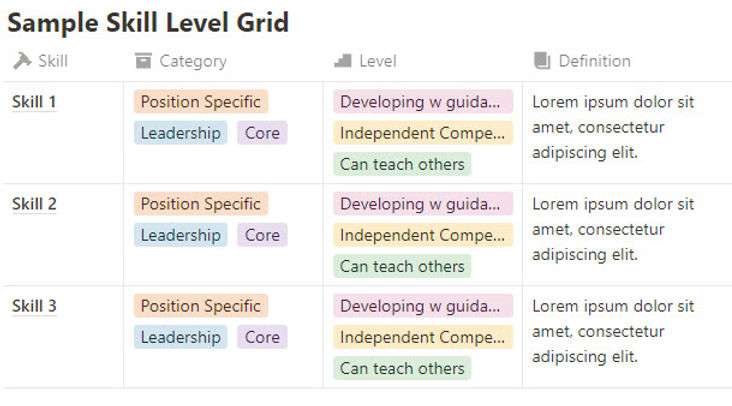
Segment your skills
Into categories and levels to streamline the organization (sampling below)
Differentiate between competencies and skills in job descriptions
This practice supports a balanced and comprehensive approach to talent management, fostering both the technical capabilities and the essential behavioral attributes needed for organizational success.

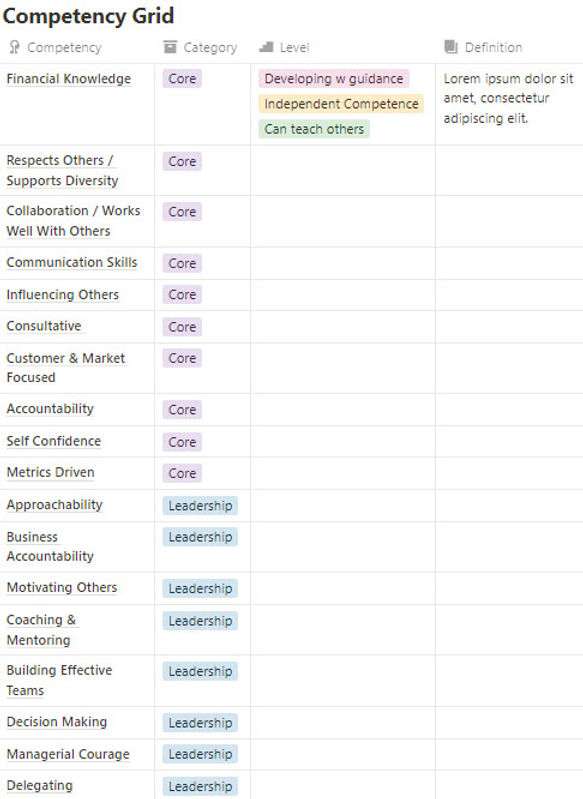
Refer to our refined list of leadership and general competencies (shown below), which has been meticulously curated to a minimalist level. This comprehensive yet succinct compilation covers nearly every essential competency, aside from those specific to certain positions, ensuring clarity and focus in job descriptions.
Step 5 – Revise Job Descriptions
Develop a new job description template or revise your current job description format(s) to include and emphasize skills. As job updates are made, you can decrease the emphasis and/or requirements for educational degrees and/or years of experience based on the feedback you received in step 3 above.
Using Microsoft Word for your job descriptions?
-
- If so, check out our free guide to help streamline and organize your catalog with SharePoint and Office.
Looking for a purpose-built software to write, update, and maintain your job descriptions?
-
- Request a demo of Mosh JD. Mention this guide for a 10% discount through August 2024!
Step 6 – Communicate & Iterate
Clearly communicate the reasons for this shift to all employees, emphasizing how it aligns with organizational goals and benefits everyone by creating clearer, more objective criteria for success. Provide ongoing support and resources to help employees and managers adapt to the new approach, including training sessions, FAQs, and one-on-one assistance.
Track the progress of this initiative by regularly reviewing the effectiveness of new job descriptions in meeting organizational goals.
Additionally, gather feedback from managers and employees to identify any challenges and continuously improve the job descriptions and related processes. This iterative approach ensures that the transition is smooth and that the job descriptions remain relevant and effective over time. Conduct regular maintenance of the system to ensure JD accuracy over time.
Step 7 – What’s Next?
Next steps include adjusting your recruitment strategies to incorporate skill assessments and work sampling, to provide a more accurate evaluation of a candidate’s abilities.
Additionally, aligning compensation with the successful application of skills to reward employees for acquiring skill mastery will motivate and retain top talent.
By prioritizing skill-based job descriptions and supporting them with targeted training and fair compensation, your organization can build a more competent and adaptable workforce, ready to meet the demands of the future.
Simplify Your Initiative with Purpose-Built Job Description Software
Mosh JD makes this entire process easier by establishing a system to facilitate the transition to skill-based job descriptions.
This will save you hours per job description while transitioning to skill-based jobs.
-
- Curate sample skill lists from our job content library
-
- Draft skill lists with Ai
-
- Customize templates and lock down job structures with role-based permissions
- Simplify collaboration for internal feedback on skills & competencies
- Maintain version control with historic lookback and recordkeeping
- and more
Watch the video here.