

When compensation teams start market pricing, they often jump straight into salary survey data. But there’s a critical step many miss: ensuring their job descriptions are clear, consistent, and benchmark-ready.
In today’s competitive job market, crafting a benchmarkable job catalog is no longer a luxury – it’s a necessity. Without a standardized job catalog, even the best salary data can lead to misaligned benchmarks, pay inequities, and decision fatigue.
Updating your job catalog in just 30 days might sound ambitious, but it’s entirely achievable. In this guide, we’ll walk you through a practical, step-by-step 30-day plan to transform your job catalog into a solid foundation for accurate compensation benchmarking.
Key Takeaways
- Compensation benchmarking is only as accurate as the job data it’s built on.
- Outdated or inconsistent job descriptions can lead to poor survey matches and pay inequities.
- This 30-day plan walks you through auditing, cleaning, standardizing, and finalizing your job catalog.
- Collaborative updates and structured templates are essential for benchmarking success.
- A clean, centralized job catalog sets the foundation for confident, data-driven pay decisions.
The Importance of Job Benchmarking
Before diving into the process, let’s explore why job benchmarking is crucial. Accurate job benchmarking is the backbone of a fair and competitive compensation strategy. It lays the groundwork for ensuring your organization offers salaries aligned with market standards. Without it, compensation decisions can become arbitrary, leading to employee dissatisfaction, lengthy time to hire, and high turnover rates.
Why Job Benchmarking is Essential for Compensation
Job benchmarking is your organization’s compass for compensation decisions. It ensures that employees are paid fairly and competitively, which is vital for attracting, motivating, and retaining talent. When your compensation packages are aligned with industry standards, you not only attract top talent but also foster a culture of fairness. This alignment is crucial for effective talent management and training, as it provides a clear framework for evaluating and adjusting compensation packages.
Moreover, benchmarking enhances transparency and trust within your organization. Employees are more likely to feel valued and engaged when they perceive their pay as fair. This, in turn, boosts organizational loyalty and productivity. Salary benchmarking is not just about numbers; it’s about building a compensation strategy that resonates with your workforce and aligns with your business goals.
The Impact of Accurate Job Descriptions on Benchmarking
Accurate job descriptions are the foundation of successful job benchmarking. When job descriptions are clear and precise, they eliminate ambiguity and lead to more accurate compensation decisions. This clarity is essential for aligning roles with salary surveys and performance metrics.
Well-defined job descriptions also streamline communication between HR and compensation teams. They provide a common language for discussing roles, skills, and qualifications; vital for crafting a cohesive compensation strategy. Ultimately, precise job descriptions are the linchpin of effective benchmarking, ensuring that your compensation practices are both competitive and equitable.
Inaccurate or inconsistent job descriptions create ripple effects across compensation strategy. They lead to:
- Poor survey matching and bad data comparisons
- Pay inequities due to misaligned job levels
- Difficulty explaining or defending pay decisions
But with a benchmarkable job catalog, you get:
- Clean survey matches and stronger market insights
- Repeatable processes for job updates and pricing
- A scalable foundation for compensation governance
Week 1: Audit What You Have
In the first week, your goal is to assess the current state of your job descriptions. This foundational step is crucial for identifying inconsistencies, outdated information, and gaps that need immediate attention. By the end of this week, you’ll have a clear understanding of your job catalog’s current status, setting the stage for standardization.
Goal: Identify gaps, inconsistencies, and duplication in your job catalog.
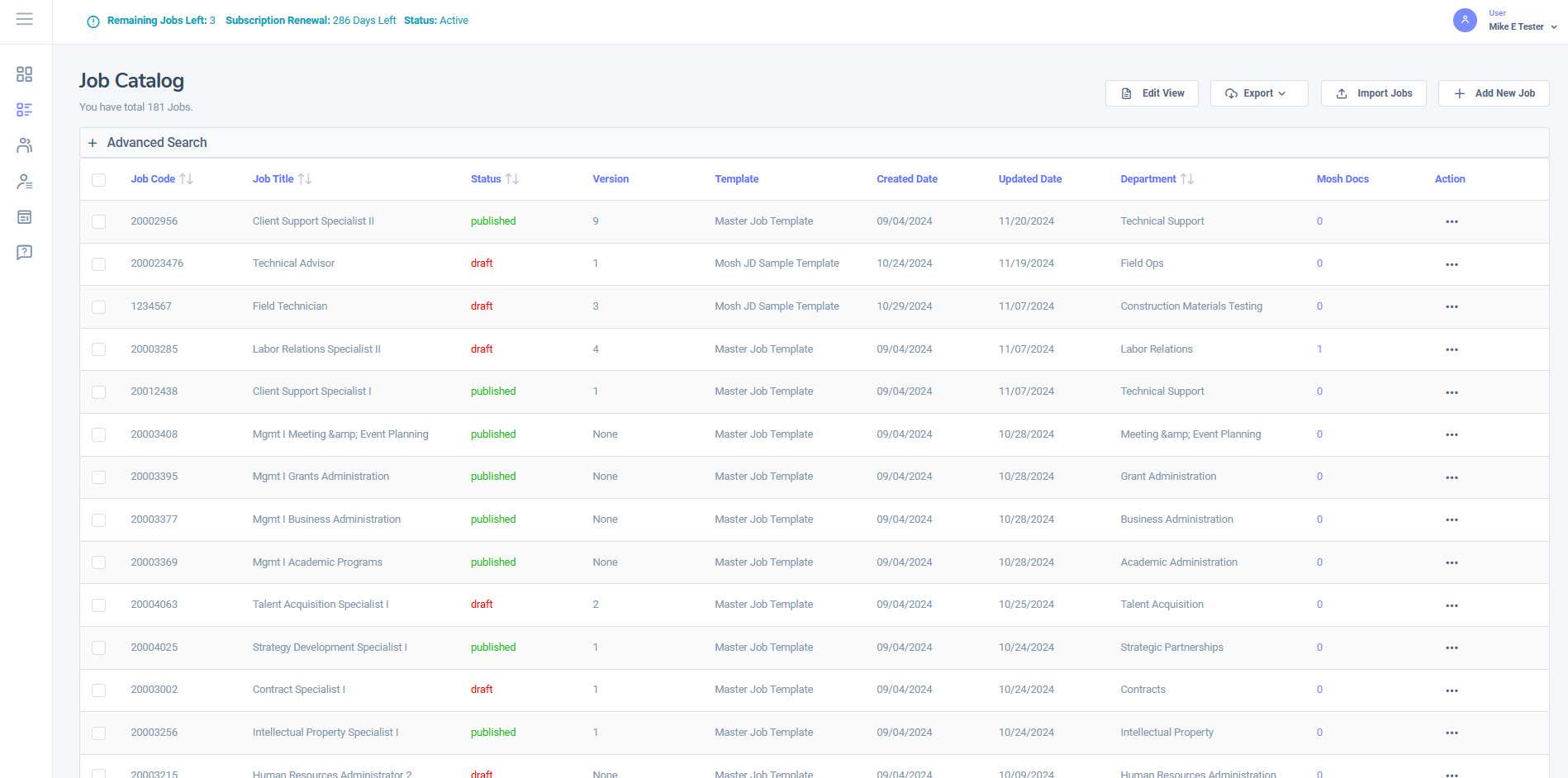
Start by collecting all existing job descriptions wherever they live (Word docs, spreadsheets, HRIS exports, shared drives).
This week is all about taking stock:
- List all active job titles in your organization
- Flag missing, outdated, or duplicate descriptions
- Identify inconsistent formats & vague responsibilities
- Look for job title inflation or mismatches between titles and actual responsibilities
Use a job inventory tracker to centralize your findings. If you’re using a job description platform like Mosh JD, this process can be accelerated through automatic imports and version tracking.
Outcome: A clear map of the current state of your job catalog.
Week 2: Standardize and Structure
Standardization is the key to ensuring consistency and clarity across your job catalog. By the end of this week, you’ll have uniform job description templates(s) that standardize job content across your job catalog, families, and job groups.
Goal: Create a consistent framework across all job descriptions.
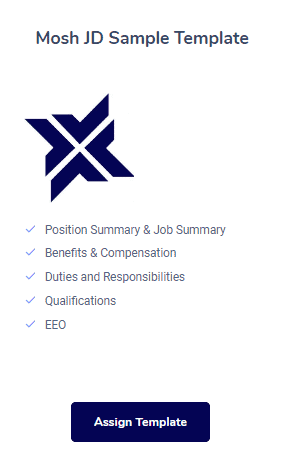
Standardizing your job content is critical before matching to salary survey data. Focus on:
- Adopt a consistent template: title, summary, responsibilities, qualifications, location, FLSA status, job level, etc.
- Aligning titles with external market norms (avoid inflated titles)
- Defining job families and levels
- Apply consistent, survey-friendly language
This sets the stage for reliable job matching and market pricing. It also helps ensure jobs are organized in a way that aligns with how compensation surveys segment roles.
Outcome: A standardized job description framework(s) for all jobs across your inventory.
Pro tip: Use AI-powered editing tools to help rephrase outdated or inconsistent job descriptions and align them with survey job structures.
Week 3: Clean and Collaborate
Week 3 is all about bringing stakeholders into the process to validate, update, and finalize job descriptions. This ensures that every role is accurate, aligned, and ready for benchmarking without the chaos of organizing scattered feedback or version confusion. Prioritize critical and problematic roles first – and get those roles updated first. If your job inventory is substantial, you may want to break updates into phases.
Goal: Validate content with stakeholders and finalize updates.
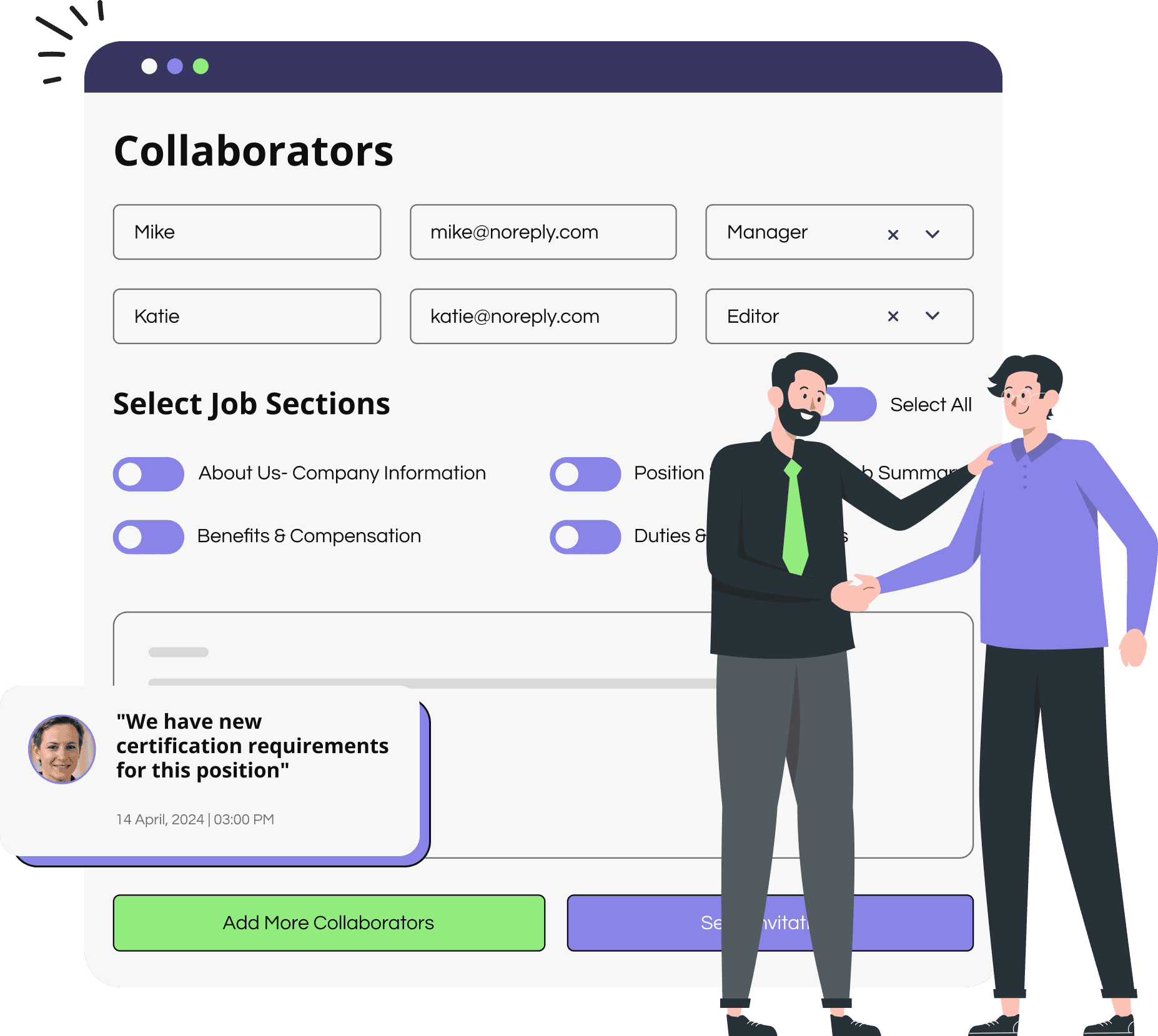
Once your templates and structure are in place and you have created an updated draft job description, route the updated jobs to HRBPs, managers, and department leaders for input.
Prioritize:
- High-impact roles (critical roles, benchmark jobs)
- Jobs with unclear or outdated content
- Roles flagged in week 1 as problematic
Collaboration should happen in a centralized, trackable way to avoid back-and-forth email threads, scattered suggestions, and version confusion. Role-based access and commenting workflows like those in Google Docs or Mosh JD can simplify this effort.
Outcome: A reviewed and aligned job catalog, ready to be finalized.
Week 4: Finalize and Benchmark
Week 4 is all about execution. Lock in your updated job descriptions and confidently map them to survey data so your compensation benchmarks reflect reality and support accurate, equitable pay decisions.
Goal: Complete your job catalog update and begin market pricing.
With clean, structured job descriptions in hand, you’re ready to start benchmarking:
- Lock final versions into your job description library
- Map jobs to salary survey matches (e.g., Mercer, Radford, WTW)
- Tag each job with metadata (location, function, level) for precise alignment
Consider preloading job codes and market data where possible. With an accurate catalog, you can confidently compare roles to external data, ensure internal equity, and inform pay decisions.
Leveraging Tech to Update Jobs Faster
Leveraging tools like Mosh JD can simplify the job description management process and enhance the accuracy of your benchmarking efforts.
Introduction to Mosh JD – “CRM” for Job Description Management
Managing job descriptions with spreadsheets, shared drives, or disconnected HR tools leads to version chaos, slow collaboration, and inaccurate job content.
Mosh JD changes that by giving compensation and HR teams a centralized, structured platform built specifically for job description management—think of it as a CRM, but for your job architecture.
Just like a CRM helps sales teams track, update, and collaborate on customer records, Mosh JD helps HR teams:
- Build a clean job description library with standardized formats
- Track version history and ensure audit-ready compliance
- Collaborate with HRBPs and managers through controlled workflows
- Tag and organize jobs by level, location, family, or function
- Accelerate survey matching and compensation benchmarking with accurate data
With Mosh JD, your job descriptions become dynamic, reliable, and accessible—making benchmarking easier, updates faster, and decisions more defensible.
Click here to watch a short 1 minute demo video of Mosh JD.
Benefits of Using Technology for Job Descriptions
Traditional job description management is fragmented, time-consuming, and prone to human error.
By adopting purpose-built technology like Mosh JD, organizations gain major efficiencies and reduce risks:
- Consistency at scale: Standardize job formats across departments and locations
- Faster updates: Edit, approve, and deploy updates without documentation chaos
- Improved accuracy: Maintain version control and eliminate outdated content
- Simplified collaboration: Enable HR, managers, and comp teams to work in sync
- Benchmarking readiness: Quickly align jobs with survey data through structured metadata
Technology transforms job descriptions from static documents into living assets that drive better compensation outcomes, support compliance, and enable smarter workforce planning.
Final Thoughts
Compensation benchmarking doesn’t start with survey data. It starts with job clarity. By following this 30-day plan, you’ll have a clean, consistent, and centralized job catalog that gives your team the confidence to benchmark accurately, make data-driven pay decisions, and scale compensation programs with integrity.
Ready to simplify your job catalog cleanup? Mosh JD helps compensation teams build, manage, and govern job descriptions at scale. Book a demo today!