

Compliance Starts With Job Data. Most Organizations Aren't Ready.
Pay transparency laws are expanding, pay equity scrutiny is intensifying, and FLSA classification challenges are growing. Sustainable compliance in this environment depends entirely on having accurate, consistent, and defensible job data underneath your compensation decisions. Mosh JD delivers that exact infrastructure, giving HR and Total Rewards leaders a reliable foundation that stands up to scrutiny.

Is your job architecture built to adapt to changing regulations?
Regulatory pressure continues to rise, leaving HR and compensation leaders with little margin for error. Organizations face a multi-front compliance challenge as pay transparency laws expand, pay equity litigation intensifies, and FLSA classification practices face increased scrutiny. These distinct regulatory issues cannot be solved in a vacuum because they all share a single, underlying vulnerability: the quality, accuracy, and consistency of your job descriptions.
More than a third of U.S. workers are now covered by state or local pay transparency laws requiring salary ranges to be disclosed in job postings, and that number is growing. Posting a salary range is the visible requirement. The invisible requirement is that the range has to be defensible. It must be grounded in a documented, consistent methodology that connects job requirements to market data to pay grades. Establishing that methodology is impossible without accurate job descriptions at the foundation.
The defensibility of any pay equity analysis hinges directly on your core job architecture, whether you are running a proactive audit or responding to regulatory scrutiny. To justify pay variations between employees in similar roles to regulators or legal teams, you must present documented, verifiable evidence of differences in job content. If your job descriptions are vague, outdated, or inconsistent, your compliance defense will immediately fall apart.
Exempt versus non-exempt classification decisions depend entirely on the actual, day-to-day responsibilities of a role rather than its title. When job descriptions fail to accurately detail a role's duties, decision-making authority, and skill requirements, defending your FLSA classifications becomes incredibly difficult. This lack of documentation leaves the organization vulnerable to misclassification findings that carry compounding back-pay liability, penalties, and litigation exposure for every affected employee.
Why most organizations aren't as compliance-ready as they think
Most HR and comp leaders know their job descriptions need work. What they underestimate is how directly that data quality problem translates into compliance exposure. Here is where the gaps typically live:
What Compliance Exposure Actually Costs
Compliance findings don't stay in HR. The financial, legal, and reputational consequences of inadequate job data infrastructure reach across the organization — and they're rarely small.
Pay equity remediation is expensive
When a pay equity audit or enforcement action uncovers a systematic pay disparity, remediation typically requires back pay, prospective salary adjustments, and ongoing monitoring under public and regulatory scrutiny. For organizations with hundreds or thousands of affected employees, these financial corrections and the resulting reputational exposure are significant.
FLSA misclassification liability compounds with every affected employee
A misclassification finding doesn't just affect the employee who raised the issue. The ruling impacts every worker in similarly classified roles, creating liabilities that potentially span years of back pay, overtime, and financial penalties. While the exposure for a single employee remains manageable, the collective organizational liability multiplied across an entire workforce becomes unsustainable.
Pay transparency violations carry direct financial penalties
State pay transparency laws carry fines for non-compliance that vary by jurisdiction but can accumulate quickly in high-volume hiring environments. More importantly, posting salary ranges that cannot be connected to a documented, defensible methodology creates secondary exposure to employee relations issues, pay equity claims, and the reputational damage of ranges that do not reflect reality.
Regulatory scrutiny doesn't end with the initial finding
The close of an FLSA investigation or pay equity dispute often marks the start of heightened compliance scrutiny. Organizations frequently face ongoing monitoring requirements and formal consent agreements, elevating job description accuracy to a continuous risk-management protocol rather than a temporary project.
The personal stakes for HR and comp leaders are real
CHRO and Total Rewards leaders who cannot produce defensible documentation of how job architecture decisions were made face personal professional exposure. The question of how this happened and why HR didn't have a system to catch it is one nobody wants to answer in front of a board, a regulator, or a courtroom. To help mitigate this risk, specialized workflows are regularly detailed for HR leaders facing these shifting demands.
What compliance readiness actually looks like
Compliance confidence is built on a foundation of accurate, consistent, and fully documented job data. This structured approach ensures the organization can successfully resolve high-stakes scrutiny and audit questions before they transform into adverse findings.

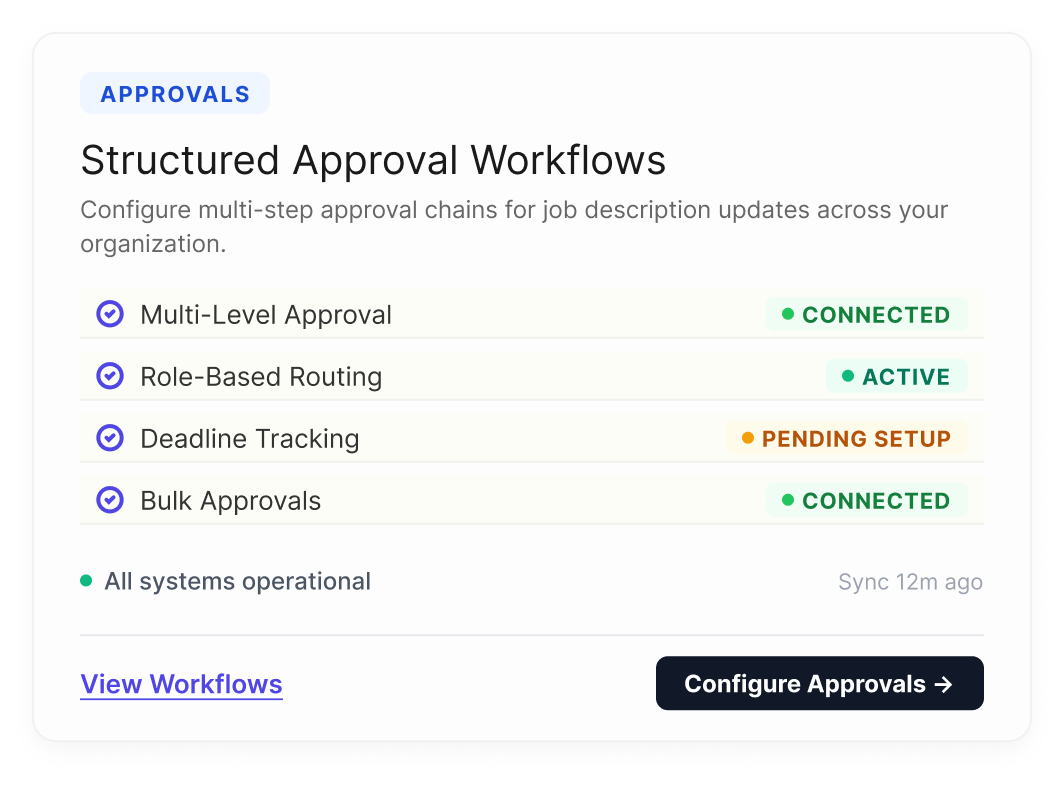
This means having a consistent structure, accurate role descriptions, and clear level differentiation across every function, business unit, and location. When two roles are placed in the same pay grade, the job descriptions support that decision. When they are placed in different grades, they support that too.
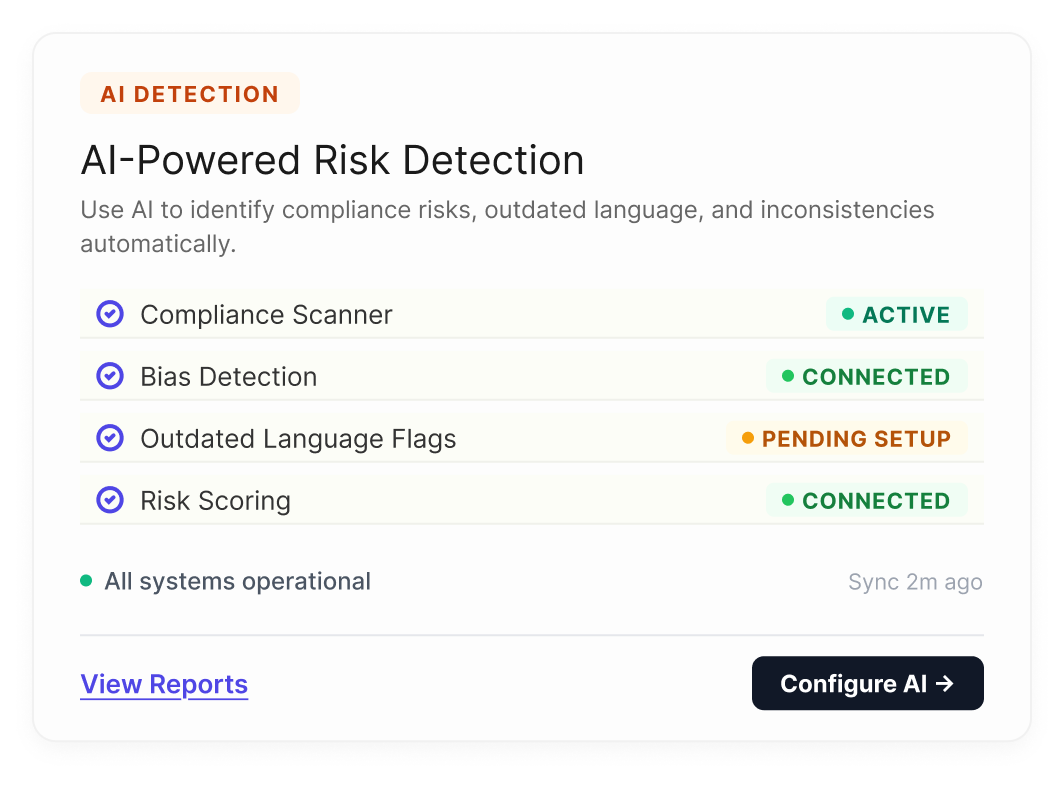
AI-powered analysis of your job inventory surfaces inconsistencies, flags potential comparability risks, and identifies where the job architecture may not support the pay decisions built on top of it, while there is still time to address them proactively.
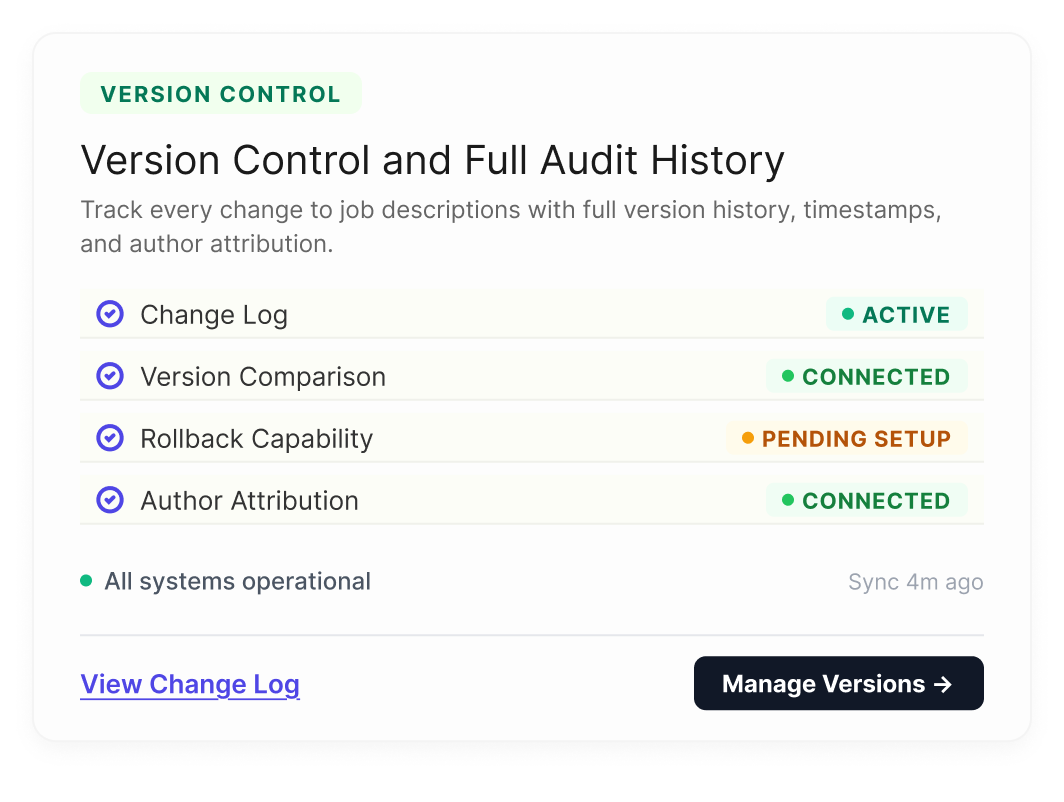
This process captures every version of your job descriptions along with all associated edits, approvals, and structural justifications. This proactive record-keeping ensures the organization can immediately deliver complete, accurate documentation whenever under regulatory, internal, or legal scrutiny.
When salary ranges are connected to job descriptions that accurately reflect role scope, and those descriptions are connected to a documented benchmarking methodology, pay transparency compliance becomes a stable process instead of a scramble.
When job descriptions accurately describe duties, decision-making authority, and skill requirements, and those descriptions are version-controlled and approved, the foundation for exempt versus non-exempt classification decisions remains documented and defensible.
As pay transparency requirements expand, pay equity enforcement intensifies, and FLSA standards evolve, organizations with clean, structured, maintained job data adapt, while organizations without it repeatedly scramble.
How Mosh JD Creates a
Compliance-Ready Job Architecture
Mosh JD doesn't provide legal advice or make compliance determinations — that's what your legal team and compliance advisors are for. What Mosh JD provides is the job data infrastructure that makes their work possible and your organization's position defensible. Here's how.
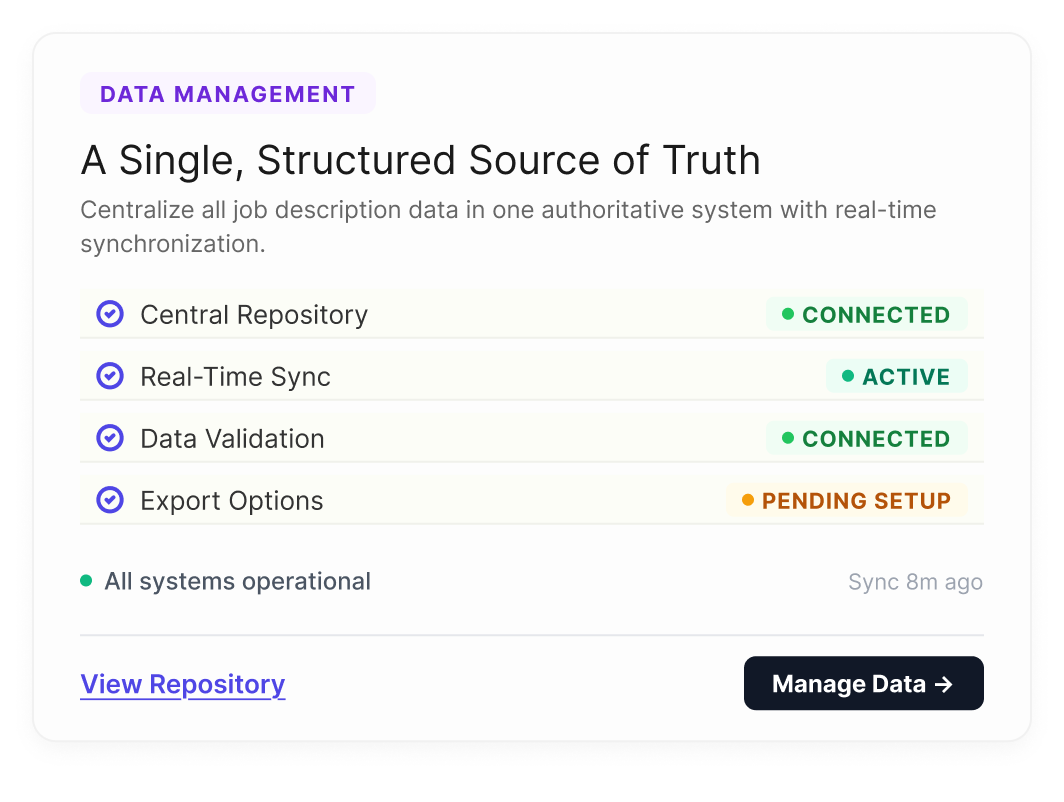
A Single, Structured Source of Truth
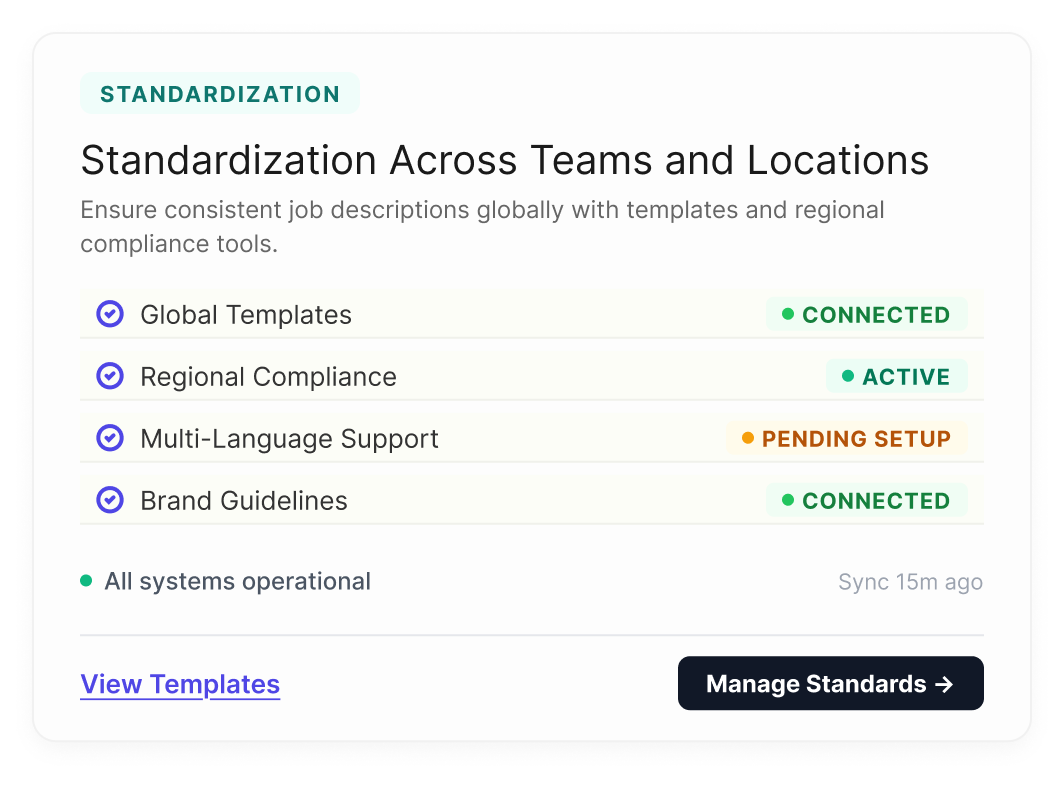
Every job description lives in one governed system that keeps files organized, consistent, and accessible to the right people with the right permissions. When every stakeholder works from the same version of the same document, the inconsistency that creates compliance risk is eliminated by design. You can view the operational setup behind this on our centralized job description database platform overview.
Where a strong job data foundation changes the compliance outcome
For Legal and Compliance Teams
Mosh JD provides your legal stakeholders with instant access to immutable version histories, time-stamped stakeholder approvals, and cross-functional audit trails. When a regulatory inquiry or legal challenge occurs, your defense is backed by verifiable, historical system records rather than fragmented emails or undocumented conversations.
What Mosh JD is and isn't
Mosh JD serves as a specialized job description management platform designed to support high-stakes compliance initiatives through robust data infrastructure, complete audit trails, and AI-driven analysis.

What HR Teams Are Saying
A job description platform that just works.
“Finally, a job description platform that just works. Mosh JD was incredibly easy to learn, the usability is fantastic — it’s a breath of fresh air compared to the overly complicated systems we’ve looked at.”

— Collette, VP of HR
I can’t recommend Mosh JD more!
“I’ve been in HR since 2006 and used several different JD management tools over the years and I can’t recommend Mosh JD more! The tool itself is super slick and the guys building and supporting the tool are all about customer service.”

— Nick Howell, CCP, PHR, SHRM-CP
Powerful without being overly engineered.
“We were looking for a solution that wasn’t bloated with unnecessary features, and Mosh JD hit the sweet spot. It’s powerful without being overly engineered — exactly what our lean HR team needed.”

— Elizabeth, VP of Total Rewards
The compliance landscape is accelerating. Match it with accurate data.
Organizations that navigate this landscape confidently rely on clean, accurate, and fully documented job data. Mosh JD delivers the exact infrastructure to build that foundation.