

Maintain Hundreds of Accurate Job Descriptions without Thousands of Hours of Work
Roles are changing faster than ever. Responsibilities shift, skills evolve, team structures reorganize and job descriptions quietly fall behind. When they do, every function that depends on them operates on a version of reality that no longer exists. Mosh JD gives your organization one system to keep job descriptions accurate, governed, and current at any scale.


The Problem Isn't That People Don't Care. It's That the System Doesn't Work.
Most organizations don't have a job description problem because HR is negligent. They have one because there's no system that makes job description accuracy at scale a manageable, sustainable process.
Job content lives in decentralized SharePoint folders, Google Drive, and email attachments with no single source of truth and no way to know which version is current. There's no governance process that ensures consistency. There's no structured way to collect input from the people who know what roles actually require. There's no visibility into which jobs have drifted, which ones are outdated, and which ones have never been touched since they were written three years ago.
So roles change. Responsibilities shift. Teams restructure. And the job descriptions don't follow — because following them manually, across hundreds of roles, across dozens of stakeholders, without a system built for it, is simply not a realistic ask.
The consequences don't stay inside HR. They spread.
The Three Root Causes:
1- Decentralized files with no source of truth
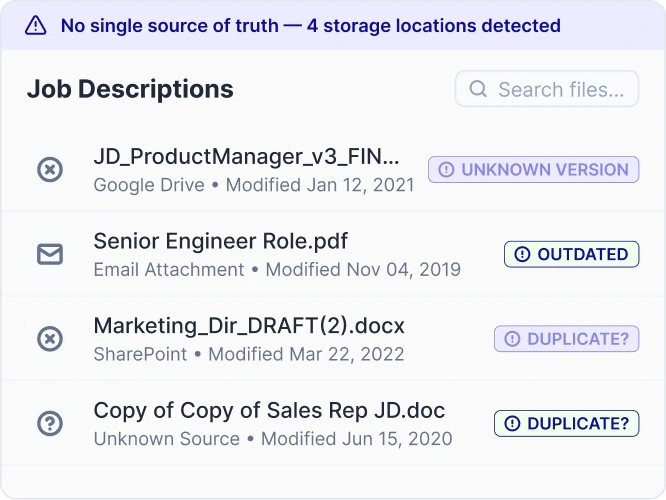
When job descriptions live across email, shared drives, and local folders, there is no reliable version, only the most recently saved copy of a file that may or may not reflect what the role actually requires. Nobody knows which version is right. Nobody can govern a process built on files that exist everywhere and nowhere at once.
2- No governance process that enforces consistency
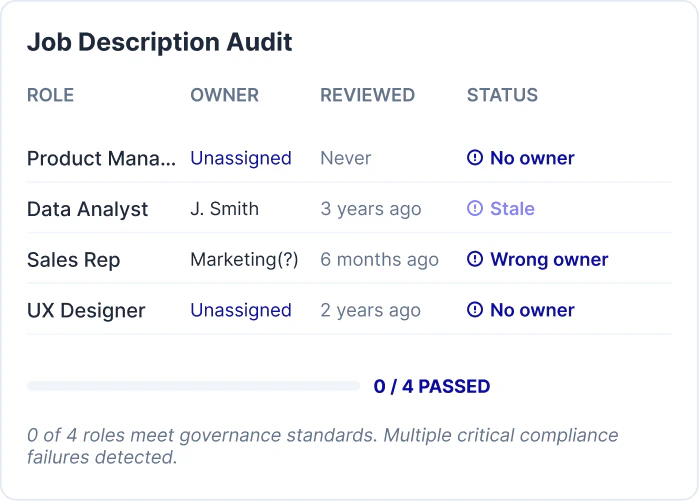
Without structured templates, access controls, and approval workflows, every team creates and updates job descriptions their own way. Formats vary. Required fields get skipped. Updates happen without review. The catalog fragments silently, one role at a time, until consistency is a memory.
3- Fragmented communication between teams
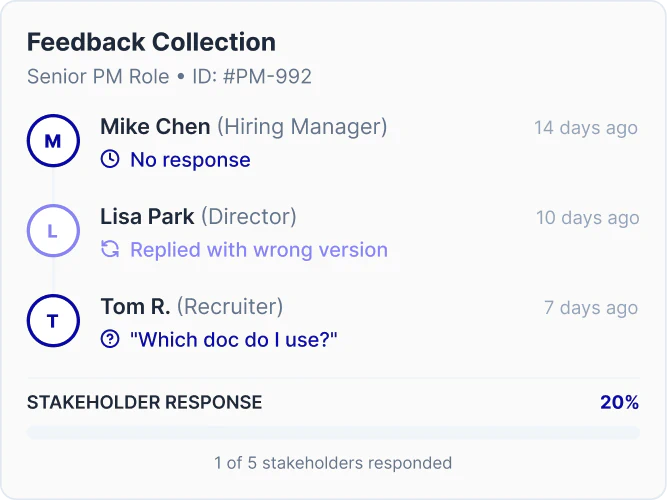
The people who know what a role actually requires, hiring managers, department heads, subject matter experts, are never in the same place as the people responsible for documenting them. Feedback happens over email. Updates get lost in threads. Nobody has a reliable way to collect, review, and incorporate input from the people closest to the work.
This Isn't a Documentation Problem. It's a Business Problem.
When job descriptions don't match reality, the damage doesn't stay contained. It propagates across every function that depends on job data to operate — and the costs compound in ways that rarely get traced back to their source.
"We're paying people wrong and we don't know it."
Compensation benchmarking is only as reliable as the job data behind it. When job descriptions don't reflect what people are actually doing, you're matching to the wrong survey jobs — and either overpaying, underpaying, or building pay equity problems you won't discover until someone files a complaint or walks out the door. The survey data isn't the problem. The job data you fed into it is.
"We keep hiring the wrong people and the problem always gets blamed on recruiting."
When a posting doesn't reflect the real role, the wrong candidates apply. Recruiters source the wrong profile. Hiring managers interview against a standard that was never written down. Someone gets hired. It doesn't work out. And everyone wonders why.
What that costs in real terms: mismatched hires, early turnover, recruiting budgets wasted on searches that had to be restarted, and a slow erosion of trust between TA and the hiring managers who keep saying "that's not what I asked for." The root cause of most pipeline quality problems isn't sourcing strategy — it's job description accuracy.
"The problem isn't your recruiters. It's the job description they're working from."
When a job description doesn't reflect the real role, hiring managers evaluate candidates against a standard that exists only in their heads. New hires show up to a job that doesn't match what they were sold. Turnover follows. The blame lands on recruiting. But the problem started with a job description written two years ago that nobody updated — and a system that had no way to catch it.
"I'm spending all my time chasing updates instead of doing the work that matters."
For the HR generalists responsible for maintaining the job catalog, inaccurate job descriptions aren't an abstract risk — they're a daily reality. Every comp cycle brings the same scramble to update roles before survey matching. Every new hire opens a conversation about whether the job description actually reflects the role. Every audit surfaces documentation that was last touched two years ago.
The maintenance burden never goes away. It just accumulates — until it becomes a project that takes months to fix, instead of a process that stays manageable all year.
When Job Descriptions Are Accurate, Everything That Depends on Them Works Better
Accurate job descriptions aren't a documentation achievement. They're an operational foundation. When every role in your catalog reflects what it actually requires, the downstream benefits reach every function that touches job data.
One System. Every Team. One Version of Every Job.
Mosh JD replaces the decentralized file chaos with a single, governed job description platform, purpose-built for the way HR and compensation teams actually work.
Every job description lives in one place. One current version. Accessible to every function that needs it — comp, TA, HR, and hiring managers. No more hunting for the right file or wondering which version is current.
Mosh JD's AI helps write, refine, and update job content using your industry context and organizational job architecture — so staying current doesn't require starting from scratch every time a role evolves. Run catalog analysis on demand to surface which jobs have drifted, which skills are missing, and where your architecture has fragmented.
Share job descriptions for review with a single link — no login required for stakeholders. Collect feedback from hiring managers, department heads, and subject matter experts in one place, with HR in control of what gets incorporated.
Templates, access controls, and publishing workflows ensure every job description follows your standards — and that updates only go live after the right people have approved them.
Every edit is tracked automatically — who changed it, what was modified, and when — so your team always knows which version is current, and you have a complete audit trail when compliance requires it.
When a job is published in Mosh JD, it flows to your HRIS, ATS, and compensation platform — so the accuracy you've maintained in your catalog is the accuracy every downstream function operates on.
The Pain Looks Different Depending on Where You Sit. The Solution Is the Same.

Compensation & Total Rewards
Your benchmarking is only as good as the job data behind it. Mosh JD keeps your catalog accurate so survey matches reflect current scope and skills — and pay decisions don't create equity problems you'll discover too late.

HR Leaders
Inaccurate job descriptions create hiring failures, performance management gaps, and compliance risk that all trace back to documentation that fell behind reality. Mosh JD gives your team the system to stay ahead of it.

Talent Acquisition
Pipeline quality starts with job description accuracy. When postings reflect the real role, recruiters source the right candidates, hiring managers get what they asked for, and searches don't restart because the brief was wrong.

HR Generalists
The maintenance burden is real — and it doesn't have to be this hard. Mosh JD gives you the tools to keep your catalog current without the manual scramble that makes every comp cycle and every audit feel like a crisis.
The system of choice for sophisticated people teams.
A job description platform that just works.
“Finally, a job description platform that just works. Mosh JD was incredibly easy to learn, the usability is fantastic — it’s a breath of fresh air compared to the overly complicated systems we’ve looked at.”

— Collette, VP of HR
I can’t recommend Mosh JD more!
“I’ve been in HR since 2006 and used several different JD management tools over the years and I can’t recommend Mosh JD more! The tool itself is super slick and the guys building and supporting the tool are all about customer service.”

— Nick Howell, CCP, PHR, SHRM-CP
Powerful without being overly engineered.
“We were looking for a solution that wasn’t bloated with unnecessary features, and Mosh JD hit the sweet spot. It’s powerful without being overly engineered — exactly what our lean HR team needed.”

— Elizabeth, VP of Total Rewards
Frequently ask questions
Keep Your Job Descriptions Accurate Without Making It Someone's Full-Time Job
Mosh JD gives you the system to stay current at scale. Most teams are up and running in under two weeks.